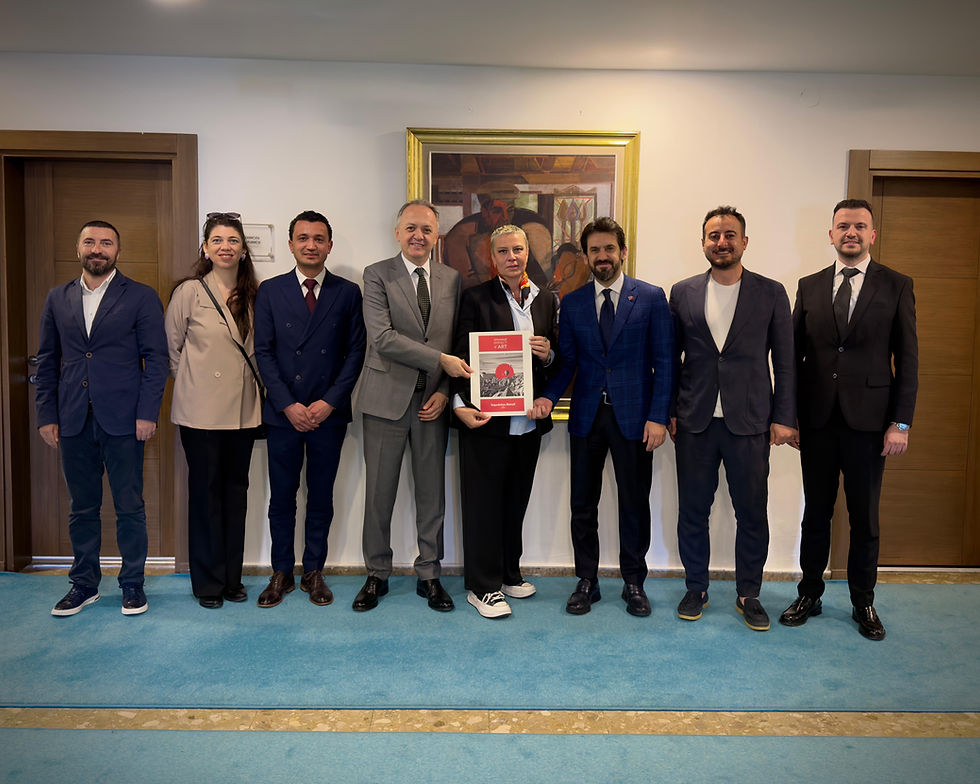
The First Edition of the Cappadocia Biennial Has Come to an End
The first edition of the Cappadocia Biennial concluded with 109 artists from 14 countries, 101 artworks, 23 venues, and more than 2 million visitors.
Bringing Cappadocia’s millennia-old geography together with contemporary art, the first edition of the Cappadocia Biennial has come to an end. Held from May 7 to September 3, 2026, the Biennial brought 101 works by 109 artists from 14 countries to more than 2 million visitors across 23 different venues throughout Cappadocia.
Spanning a vast geography from Kayaşehir to Keşlik Monastery, from Göreme to Ürgüp, Avanos to Uçhisar, and Ortahisar to Mustafapaşa, the Cappadocia Biennial chose not to confine contemporary art to a single exhibition hall, but instead placed it within the everyday life, natural fabric, and cultural memory of Cappadocia.
For four months, valleys, caves, historic structures, ancient settlements, and unconventional exhibition spaces took on new meaning through art.
As visitors explored the Biennial, they discovered Cappadocia; and as they discovered Cappadocia’s historical and natural beauty, they experienced the Biennial.
And perhaps this was the most powerful idea left behind by the first Cappadocia Biennial:
Cappadocia was not merely the place where the Biennial took place; it was part of the Biennial itself.

“so, what now?”
In its first year, the Cappadocia Biennial posed a simple yet increasingly urgent question to the world:
so, what now?
Inspired by humanity’s need to begin again in the aftermath of disasters, wars, economic crises, and inequalities, the Biennial chose “BIRTH” as the theme of its first edition.
“BIRTH” represented not only a biological beginning, but also the act of rising again, healing, transforming, and finding the courage to rebuild the future.
In line with this approach, the Cappadocia Biennial considered art not merely as a field of aesthetic expression, but as a way of thinking, creating, and encountering that makes it possible to look differently at the challenges facing individuals and society.
Artists were invited to reconsider fundamental human needs such as shelter, food, healthcare, education, clothing, and solidarity through different disciplines. Within the Biennial’s institutional approach, the artist was positioned not simply as someone who produces artworks, but as a “solution partner” capable of proposing alternative possibilities for the world.
From painting to sculpture, photography to video, installation to performance, cinema to music, a wide range of disciplines met audiences across Cappadocia through exhibitions, workshops, film screenings, educational programs, and cultural gatherings.

A Journey That Began in 48 Countries Became 101 Artworks in Cappadocia
The first edition of the Cappadocia Biennial was also the result of an international open-call process.
The open call, launched on December 17, 2025, received 1,038 applications from 48 countries. Following technical and conceptual evaluations, 94 works were selected for the Biennial through a multi-stage selection process conducted by the Selection Committee and Curatorial Committee. With the addition of seven invited works, the first Cappadocia Biennial reached a total program of 101 artworks.
Artists from different parts of the world thus came together amid geological formations millions of years old and thousands of years of cultural heritage, united around the same question:
After everything we have been through, so, what now?

From White Walls to Valleys
One of the starting points of the Cappadocia Biennial was the belief that the experience of contemporary art should not belong exclusively to museums, galleries, or art circles.
From its very first edition, the Biennial chose to spread its artworks across 23 different venues rather than gathering them in a single center.
Through this choice, art encountered not only those actively seeking it out, but also people who had simply set out to discover Cappadocia.
A visitor entering a historic building might unexpectedly encounter contemporary art, while an art enthusiast following an artwork might discover a village, valley, monastery, or historic structure they had never seen before.
In this way, the Biennial created a route that dissolved the boundary between art tourism and cultural tourism.
This was precisely Sinemasal’s fundamental objective in designing the Biennial: rather than presenting Cappadocia and art as two separate experiences, it sought to enable visitors to discover both within the same journey. Having reached 1 million visitors within its first three weeks, the Biennial completed its four-month journey with more than 2 million visitors experiencing its exhibitions by the time it closed. The intense visitor interest recorded during the early period had also been announced in Sinemasal’s press records.

Who Was the Biennial For?
The Cappadocia Biennial was not designed solely for contemporary art professionals, collectors, or the art world.
It was for those who live in Cappadocia.
For those visiting the region for the first time.
For children and young people.
For people who might be encountering art for the first time in their lives.
For artists, students, travelers, researchers, and visitors coming to Cappadocia from different parts of the world.
In short, it was for everyone—including those who may have felt that art was distant from their lives.
Sinemasal’s long-standing approach to making art accessible across different regions of Türkiye was brought to a new scale through the Cappadocia Biennial. Following a journey that has brought millions of children and young people across all 81 provinces of Türkiye together with art, Sinemasal is now focusing, through its “IMPACT of ART” approach, on the relationship art can establish with social and global issues.

“Rather than bringing art to Cappadocia, we wanted to create a space where Cappadocia and art could transform one another.”
Following the first edition, Cappadocia Biennial Director Enes Kaya reflected:
“When we imagined the Cappadocia Biennial, our aim was not simply to place artworks within this geography. We wanted to create a space of encounter where art and Cappadocia could transform one another, and where people could look at both art and this geography from a different perspective.
As the first Biennial comes to an end, what remains for us is not merely numbers. What remains is a visitor who unexpectedly encounters an artwork while walking through a valley; a child seeing contemporary art for the first time in their life; an artist who brought their work to Cappadocia from the other side of the world; a venue that opened its doors to the Biennial; and millions of people who embraced this story.
We exhibited 101 works by 109 artists from 14 countries across 23 different venues throughout Cappadocia. More than 2 million people became part of this journey. But for us, the most important outcome is this: together, we have seen that contemporary art can live and grow in Cappadocia and can become a powerful part of this region’s future.
The first Cappadocia Biennial has come to an end.
But Cappadocia’s story with art has only just been born.”

The First Cappadocia Biennial Has Come to an End
Firsts happen only once.
The first encounters created in Cappadocia’s caves, valleys, historic structures, and towns between May 7 and September 3, 2026, have now become part of Cappadocia’s memory.
For those who missed the first Cappadocia Biennial, there will never be another chance to experience the same Biennial again.
But the good news is:
This was only the first edition.
After a four-month art route extending across Cappadocia, a new question now remains:
What awaits us at the next Cappadocia Biennial?
Until we meet again to experience Cappadocia through art.

Thank You, Cappadocia
The Cappadocia Biennial was realized through a collaboration between Sinemasal Culture & Arts Association and New Saga Fikir Sanat A.Ş., under the direction of Enes Kaya, and through an extensive network of collaboration bringing together public institutions, local stakeholders, academics, art professionals, technical teams, and volunteers.
To all our supporters who believed in the dream of a biennial in Cappadocia;
to our artists who brought their works and ideas together with this geography;
to our Selection Committee, Curatorial Committee, and Advisory Board;
to the institutions, organizations, and local stakeholders who shared their venues and resources;
to our team members and volunteers who worked with extraordinary dedication for months;
and most importantly, to the more than 2 million visitors who embraced the Cappadocia Biennial and visited our exhibitions:
our heartfelt thanks.
Together, we wrote this first story.
See you at the next Cappadocia Biennial.
what now?
Now, it is time to wait for the next birth.

CAPPADOCIA BIENNIAL 2026 | 5W 2H
What? The first edition of the international Cappadocia Biennial, bringing contemporary art together with Cappadocia’s natural, historical, and cultural fabric.
When? May 7 – September 3, 2026.
Where? Across 23 different venues throughout Cappadocia, extending from Kayaşehir to Keşlik Monastery and including Göreme, Ürgüp, Avanos, Uçhisar, Ortahisar, Mustafapaşa, and Kayaşehir.
Why? To demonstrate that art is not merely a form of aesthetic expression, but also a mode of production that enables us to rethink social and global issues and develop creative and sustainable approaches.
How? Through a multi-stage evaluation of 1,038 open-call applications from 48 countries, invited artists, diverse artistic disciplines, exhibitions spread across 23 venues, and parallel events.
Who? 109 artists from 14 countries; a team, committees, supporters, and local stakeholders brought together under the leadership of Biennial Director Enes Kaya, in collaboration between Sinemasal Culture & Arts Association and New Saga Fikir Sanat A.Ş.
For whom? For everyone who wants to encounter art—from art professionals to local communities, from children and young people to travelers and visitors to Cappadocia.
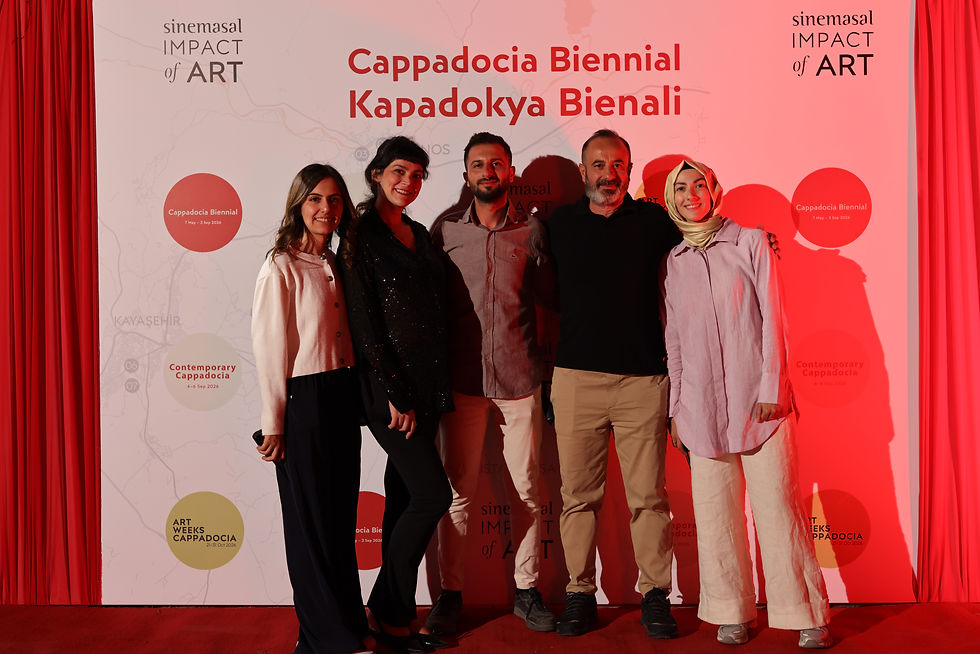
THE BIENNIAL ARCHIVE LIVES ON
Information about the 101 artworks exhibited as part of Cappadocia Biennial 2026, the participating artists, and the exhibition venues remains accessible through the Sinemasal | Impact of Art mobile application.